PolyFeed Banner
PolyFeed is an award-winning feedback analytics tool aimed to capture, analyse, and present students' interactions with feedback.

PolyFeed was developed based on stakeholder (e.g., students, educators, LA researchers) requirements and state of art feedback research such as feedback literacy, dialogic feedback, and learner-centred feedback. More than 1500 students and 300 teachers have been engaged in the design process and the tool was developed using design thinking approach.

Awards & Recognitions

Best Demo Award
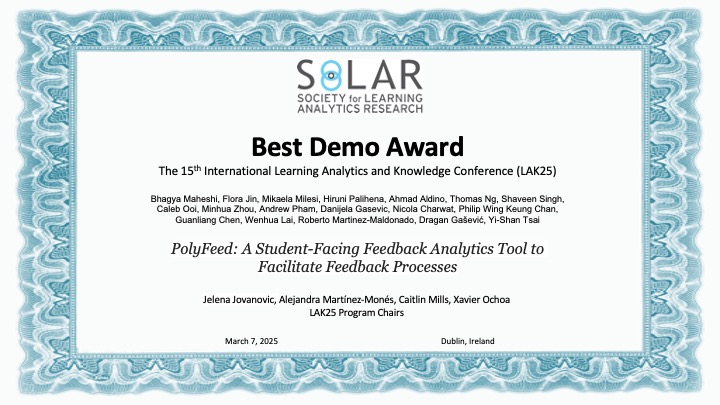
Best Demo Award - LAK25

PolyFeed Student won the Best Demo award at the 15th International Learning Analytics and Knowledge Conference. The demo "PolyFeed: A Student-Facing Feedback Analytics Tool to Facilitate Feedback Processes," showcased the features and functionalities of PolyFeed for students, along with findings from our pilot study.
Best Poster Award
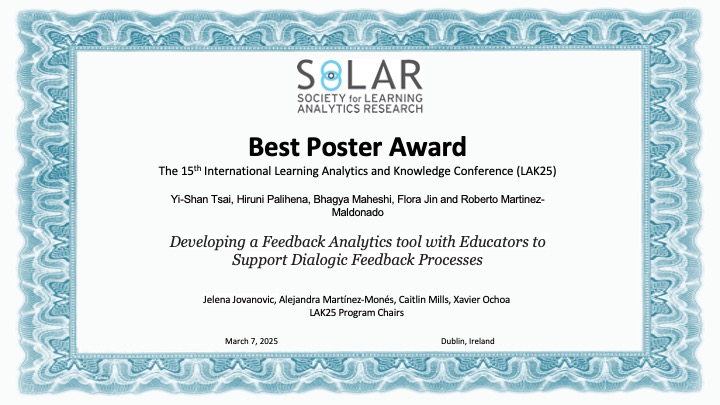
Best Poster Award - LAK25

PolyFeed Teacher won the Best Poster award at the 15th International Learning Analytics and Knowledge Conference. The poster "Developing a Feedback Analytics Tool with Educators to Support Dialogic Feedback," presents how we applied a design thinking approach to create PolyFeed for educators, supporting dialogic feedback.

PolyFeed Student

PolyFeed student consists of a Chrome browser extension and a Dashboard.

pf_student_cover
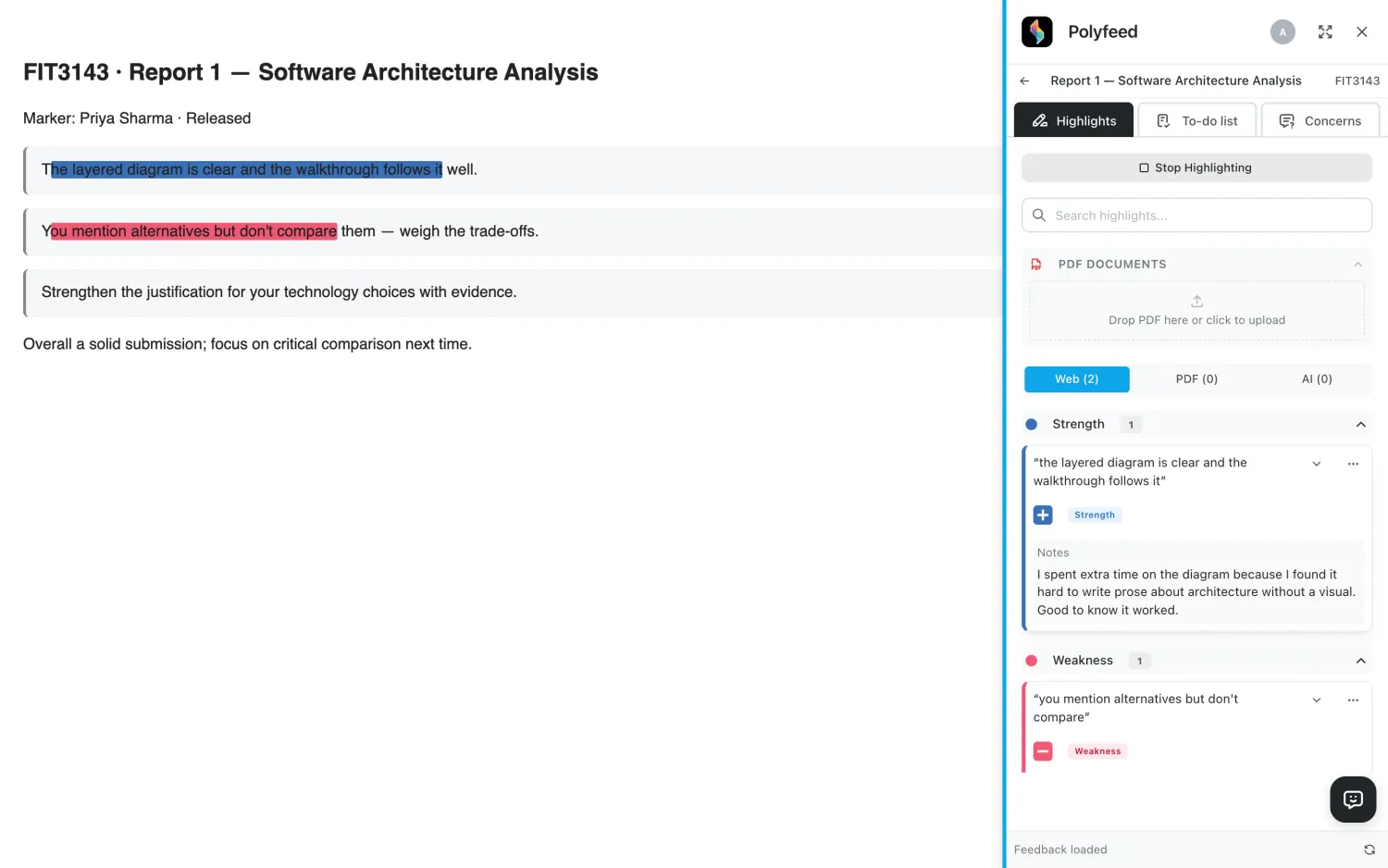
Analyse Feedback

Students can highlight and label feedback as strength, weakness, suggestion, confusion, or other

pf_note_cover
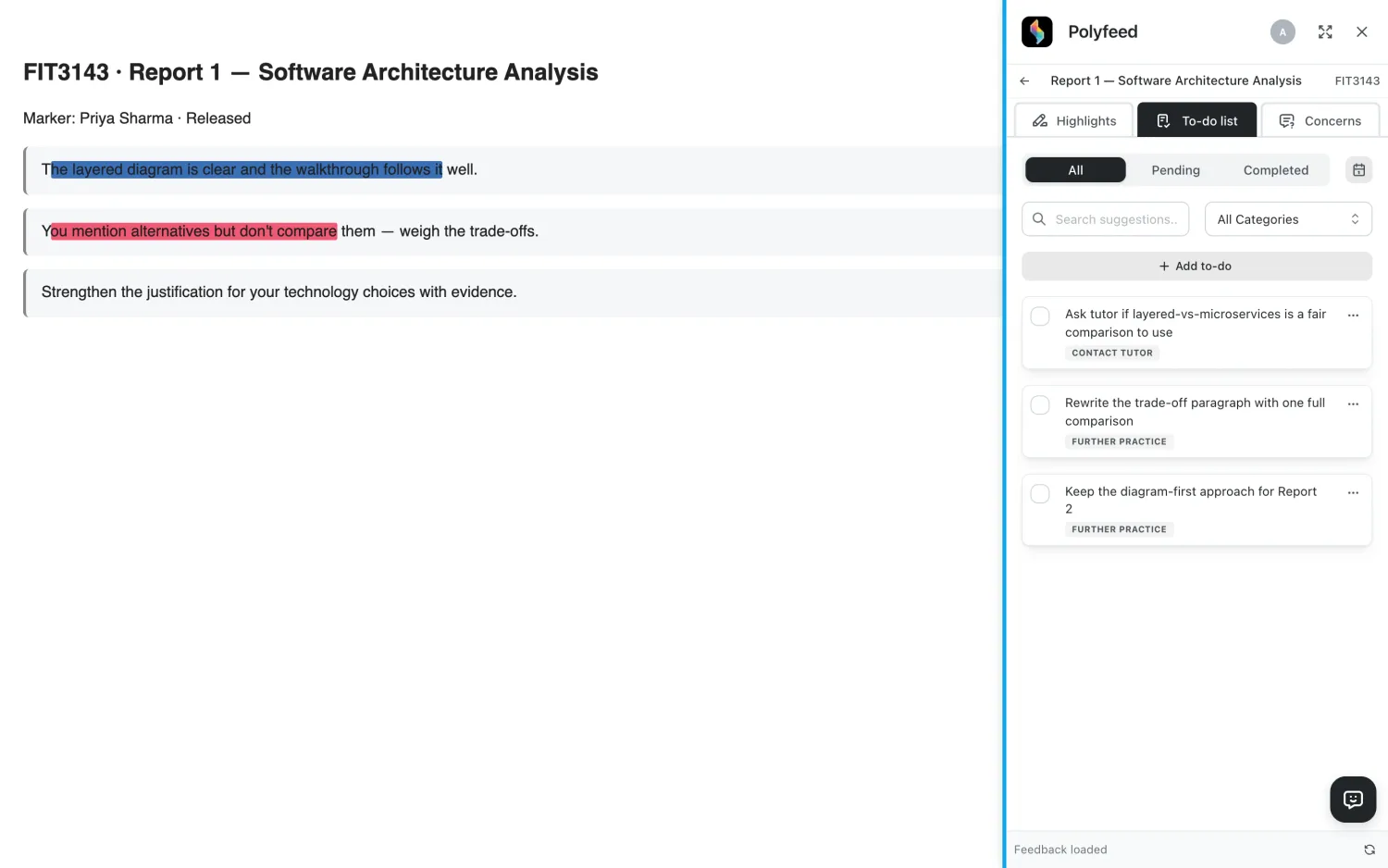
Reflect on Feedback

Students can make reflective notes or action plans.

pf_sau_cover
View Interactions with Feedback

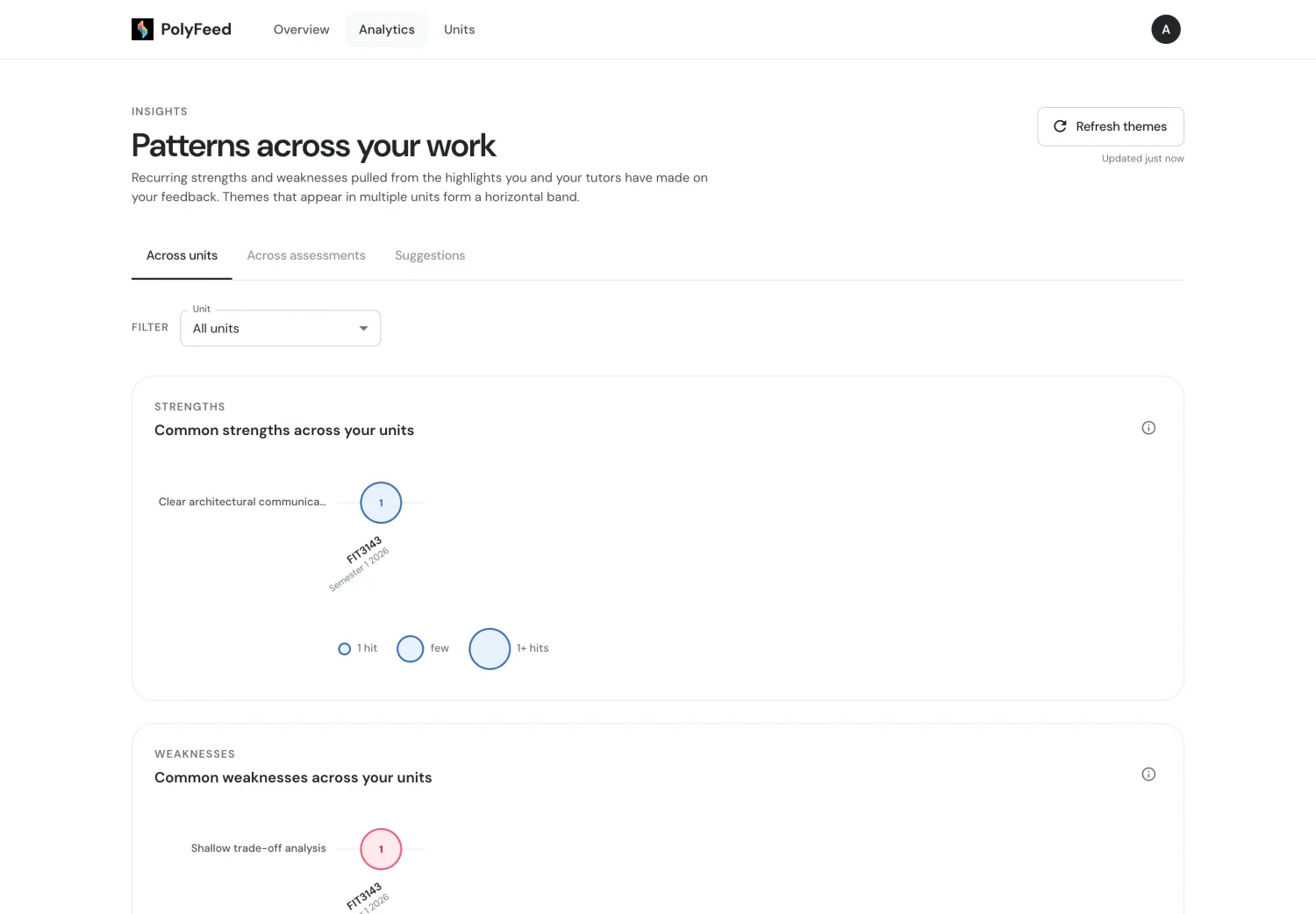
Students can view patterns emerged from their interactions with feedback.

Watch the Demo Video

PolyFeed Teacher

PolyFeed Teacher consists of a browser extension and a dashboard.

pf_t_evaluate_cover
Evaluate Feedback Quality

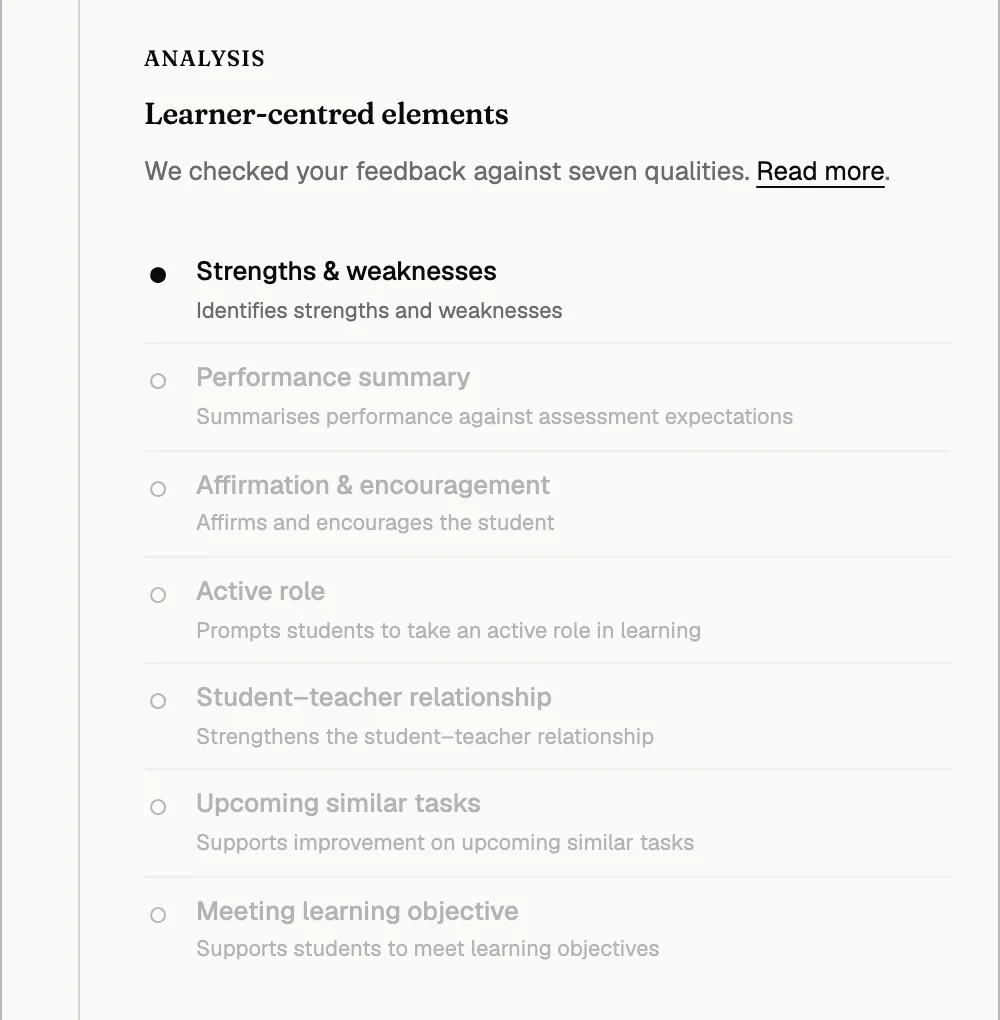
Teachers can evaluate their feedback for the alignment with learner-centred feedback elements.

pf_improve_cover
Improve feedback

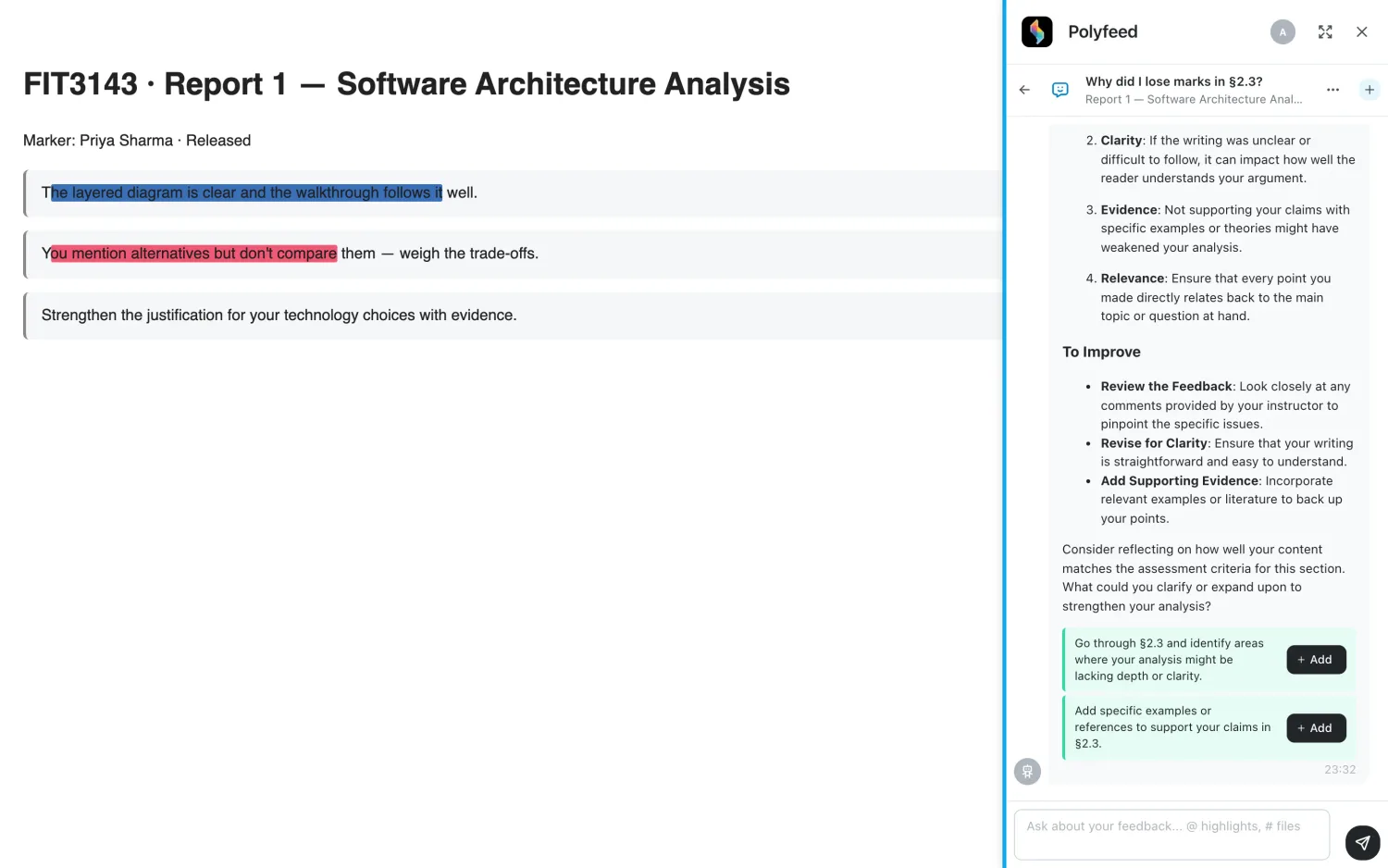
Teachers can use the suggestions from PolyFeed evaluation and GenAI to improve the feedback

pf_sau_cover
View Students' Interactions with Feedback

Teachers can view insights derived from students interactions with feedback at different class levels.

Watch the Demo Video

Publications

Feedback in K-12 and Higher Education: Educators' Perspectives

Authors: Flora Ji-Yoon Jin, Wei Dai, Bhagya Maheshi, Roberto Martinez-Maldonado, Dragan Gašević, Yi-Shan Tsai

Abstract: Feedback is essential in education, yet often studied within isolated educational sectors. This study investigates feedback practices across K-12 and higher education by surveying 254 educators to explore perceptions of effective feedback, student barriers, and methods for tracking feedback impact. Our findings reveal that higher education educators prioritise cognitive and structural feedback elements, emphasising actionable suggestions and timely delivery. In contrast, K-12 educators focus on social-affective aspects, such as feedback tone, to support a nurturing learning environment. Despite these sector-specific preferences, discrepancies exist between educators' beliefs and practices, highlighting a need for enhanced feedback literacy.

DOI: https://doi.org/10.1016/j.tate.2025.104933

Towards Supporting Dialogic Feedback Processes Using Learning Analytics: the Educators' Views on Effective Feedback

Authors: Hua Jin, Roberto Martinez-Maldonado, Tony Li, Philip Wing Keung Chan, Yi-Shan Tsai

Abstract: Feedback plays a crucial role in learning. Yet, higher education continues to face challenges regarding facilitating effective feedback processes. One of the challenges is the difficulty to track how students interact with feedback and the impact of feedback on learning outcomes. Learning analytics (LA) has opened up opportunities to enhance feedback practice with a wide array of data. However, most research seeks to deliver data-driven feedback rather than understanding how students make use of feedback and how educators can use learning analytics to support students in this process. As a first step to address this gap, our study investigated educators' views of challenges and elements of effective feedback processes in addition to their perceptions of data-driven feedback. The study found that feedback design (e.g., feedback purpose, content, and structure), educator-related factors (e.g., time constraints and resource limitations), and student-related factors (e.g., disposition, self-regulation, and sense-making) can have positive or negative impacts on the feedback process. It also highlights the need for the development of student feedback literacy. Based on the findings, we proposed ideas for an LA-based feedback tool that can be used to facilitate a dialogic feedback process and address challenges with feedback.

DOI: https://doi.org/10.14742/apubs.2022.54

Scaffolding Feedback Literacy: Designing a Feedback Analytics Tool

Authors: Flora Ji-Yoon Jin, Bhagya Maheshi, Roberto Martinez-Maldonado, Dragan Gašević, Yi-Shan Tsai

Abstract: Feedback is essential in learning. The emerging concept of feedback literacy underscores the skills students require for effective use of feedback. This highlights students' responsibilities in the feedback process. Yet, there is currently a lack of mechanisms to understand how students make sense of feedback and whether they act on it. This gap makes it hard to effectively support students in feedback literacy development and improve the quality of feedback. As a specific application of learning analytics, feedback analytics (analytics on learner engagement with feedback) can offer insights into students' learning engagement and progression, which can in turn be used to scaffold student feedback literacy. This study proposes a feedback analytics tool, designed with students, aimed at aiding students to synthesize feedback received from multiple sources, scaffold the sense-making process, and prompt deeper reflections or actions on feedback based on data about students' interactions with feedback. We held focus group discussions with 38 students to learn about their feedback experiences and identified tool features. Based on identified user requirements, a prototype was developed and validated with 16 students via individual interviews. Based on the findings, we envision a feedback analytics tool with the aim of scaffolding student feedback literacy

DOI: https://doi.org/10.18608/jla.2024.8339

Dialogic Feedback at Scale: Learning Analytics Design

Authors: Bhagya Maheshi, Wei Dai, Roberto Martinez-Maldonado, Yi-Shan Tsai

Abstract: Background: Feedback is central to formative assessments but aligns with a one-way information transmission perspective obstructing students' effective engagement with feedback. Previous research has shown that a responsive, dialogic feedback process that requires educators and students to engage in ongoing conversations can encourage student active engagement in feedback. However, it is challenging with larger student cohorts. Learning Analytics (LA) provides promising ways to facilitate timely feedback at scale by leveraging large datasets generated during students' learning. However, current LA design and implementation tend to treat feedback as a one-way transmission rather than a two-way process.
Objectives: This case study aims to improve LA design and practice to align with dialogic feedback principles by exploring an authentic dialogic feedback practice at scale.
Methods: We explored a dialogic feedback practice of a course having 700 undergraduate students. The case study used quantitative and qualitative analysis methods to investigate what students expect from feedback, how educators respond to students' feedback requests, and how students experience feedback.
Results and Conclusions: The results emphasise the need to focus on cognitive, relational and emotional aspects of the feedback process. In aligning LA with dialogic feedback principles, we propose that LA should promote the following objectives: reflection, adaption, personalisation, emotional management, and scaffolding feedback provision.

DOI: https://doi.org/10.1111/jcal.13034

Data Storytelling for Feedback Analytics

Authors: Bhagya Maheshi, Mikaela Elizabeth Milesi, Hiruni Palihena, Aaron Zheng, Roberto Martinez-Maldonado, Yi-Shan Tsai

Abstract: Feedback is an essential process of learning in higher education. Yet, capturing students' interactions with feedback is challenging, which makes it difficult to evaluate its impact. Learning Analytics (LA) is a potential solution to address this issue as it is capable of capturing and analysing learners' activities in a technology-enabled learning environment. LA often use dashboards to deliver insights derived from educational data, yet questions remain on how to most effectively communicate key insights to students. Data Storytelling (DS) is a promising technique to address this challenge by combining data, visuals and narrative to convey key insights. Co-design can facilitate the crafting of visualisations and data stories that best aligns with goals of the students. This study presents the preliminary findings from a design sprint conducted with students to co-design a prototype for a dashboard of an LA solution – PolyFeed – that captures and analyses students' interactions with feedback. In developing the dashboards, students used DS principles – Explanatory titles, Annotations, Highlighting important data points, and Decluttering – to improve the selected visualisations. The results show that the student groups perceived visualising strengths and weaknesses identified in feedback, action plans based on feedback, and trends in their performance as key aspects to include in FA dashboard. However, they primarily used two DS principles: explanatory titles and highlighting key data points to improve visualisations because the dataset was pre-dominantly qualitative. Therefore, the effective use of DS to support qualitative data should be further explored.

Workshop Link: https://ceur-ws.org/Vol-3667/

PolyFeed Team

Team Member 2
Dr. Yi-Shan Tsai

Chief Investigator

Team Member 3
Assoc. Prof. Roberto Martinez-Maldonado

Senior Resercher

Team Member 4
Prof. Dragan Gašević

Senior Resercher

Team Member 5
Dr. Guanliang Chen

Senior Resercher

Team Member 5
Bhagya Maheshi

PhD Candidate

Team Member 5
Flora Ji-Yoon Jin

PhD Candidate

Team Member 5
Mikaela Milesi

PhD Candidate

Team Member 5
Ahmad Aldino

PhD Candidate

Team Member 5
Hiruni Palihena

Project Manager

Team Member 5
Thomas Ng

Software Developer

Team Member 5
Assoc. Prof. Danijela Gašević

Collaborator

Team Member 5
Dr. Nicola Charwat

Collaborator

Team Member 5
Dr. Philip Chan

Collaborator

Team Member 5
Dr. Sadia Nawas

Collaborator


We also would like to remeber Dr. Shaveen Singh, Minhua Zhou, Aaron Zheng, Caleb Ooi, Andrew Pham, Winnie Chui, Max Verheof, Phakhanan Rataphaibul, and Assoc. Prof. Wenhua Lai who were part of the PolyFeed team and contributed in desinging, developing, and evaluating it.


For research collaboraitons and further information contact fit-polyfeed@monash.edu or Dr. Yi-Shan Tsai

Your Privacy within PolyFeed

Here is how we preserve your privacy within PolyFeed. PolyFeed is a research project hosted by Monash University. It adheres to the Monash University Privacy Data Protection procedure. Please refer to the following links to learn about the Data Protection and Privacy Procedures of Monash University:

How we use your personal information

We want you to feel confident using either PolyFeed Student and PolyFeed Teacher. Here is what you need to know,

PolyFeed is not connected to the Monash Central data lake. Therefore, some information such as emails, enrolled units (courses/ modules) are collected based on manual inputs including:

  • Your name and university email to manage log in.
  • For students: your highlights, highlight labels, notes, to-dos, ratings on feedback, feedback requests, chatbot chat history, and interactions with the features of the tool as log data.
  • For teachers: the feedback you write, the machine learning analysis we generate, your prompts used as part of ChatGPT integration within PolyFeed, and your interactions with different features of the extension.
  • In both PolyFeed student and PolyFeed teacher we also collect basic activity logs (how you use the tool) to help us improve.

No data is read or saved from other tabs or windows opened in your browser.

  • To present data about your learning (students) or teaching (teachers) in the dashboard provided to you.
  • To identify ways to improve feedback processes.
  • To support research into feedback and learning analytics.

  • Users can see their own feedback engagement data on the user dashboards.
  • Teachers can see analytics of students' feedback engagement at an aggregated level (de-identified) on the Teacher Dashboard, including feedback requests, comments, highlights and labels, feedback ratings. Teachers can also see feedback requests and comments on the feedback at individual student level (identified).
  • With ethics approval (ID: 38407) received from the Monash University Human Research Ethics Committee, the PolyFeed research team can access the collected user data to conduct research analysis for the purpose of informing learning and teaching. Any data published as part of research outputs are strictly de-identified.

  • You can ask us to delete or correct your data (Note: Deleted records are marked inactive–not permanently erased right away–within the database).
  • You can stop using PolyFeed at any time.

  • All data is stored securely in line with university standards.
  • We use encryption (HTTPS) and strict access controls.